

If there are words in this book that I can’t speak aloud, should I be the one to speak aloud about this book?
a brain dump on book clubs, interpretations, extractive reading et al.
Ok stay with me on this one! I’ve been having lots of thoughts and feelings, and I want to tease them out a bit here…
It all began with the idea of a book club. Murmur would be the perfect space for it, and I get asked all the time why I don’t do one?
And it’s got me feeling… uncomfortable.
In the last couple of years there have been quite a few new book clubs popping up both online and irl. I do like the idea in theory. But where the uncomfortable feelings come up for me is when I watch non-Black readers lead conversations about Black books.
What I’m trying to say is that I would feel uncomfortable about running a book club and attempting to facilitate a conversation around stories that aren’t from my lived experience, despite the fact that I read widely.
It’s not that I don’t think people should be reading and discussing Black books, don’t get me wrong! It’s more that I haven’t found a space where I feel:
1. safe to discuss my experience of Black books as a Black reader.
and
2. like non-Black facilitators are able to adequately comment on these stories.
I feel like I’m trying to be very careful with my words.. can you feel it too?
I think I’m scared of saying these uncomfortable feelings aloud, because I don’t want to discourage anyone from reading from experiences different from their own. I don’t want to stop the discourse. I want the opposite, in fact! My line of thinking feels so complicated, and bordering on a gatekeeping that I am actively trying to fight against.
I don’t know if I have the words for it all, but I read this quote taken from Toni Morrison’s eulogy for James Baldwin, that feels like what I’m attempting to eek out:
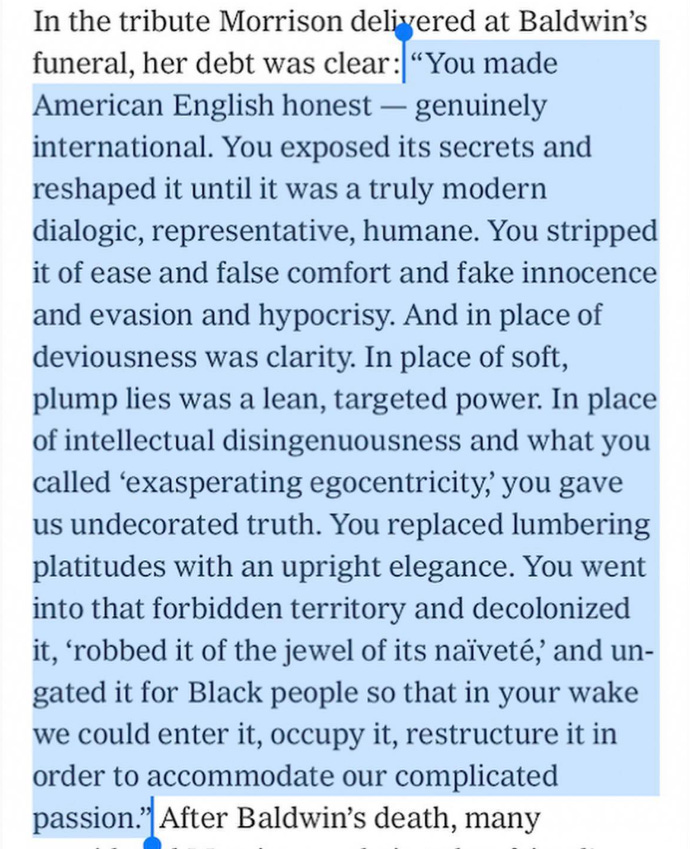
I think particularly post 2020-racial-uprising-etc, what I noticed a lot of was that with the increase in the consumption of diverse authors came a wave of interpretation, facilitation, and discourse.. and not always by the people most connected to the work. Black and First Nations texts, in particular, became subjects of discussion, extraction, even branding. And while I believe deeply in the power of reading across difference, what I keep returning to are these questions:
Who gets to interpret our stories?
and
Who gets rewarded for doing so?
The truth is that it’s often not us.
I think what I’m missing is that connection and added layer of lived experience. A space where the Black experience doesn’t feel like a hypothetical.
Once again, my issue isn’t with book clubs reading these texts, but more that I would like to see more Black creators platformed in these spaces to facilitate and give context in a way that others can’t.
I’m talking all the people building platforms or receiving invitations to explain a text that wasn’t written from their heritage, but which they’re now seen as qualified to lead others through.
These same dynamics are happening on a much larger scale too (and here’s where I feel it’s actually quite dangerous) through the commodification of story via what I guess we can call “summary culture”. Without naming names, there are apps now that will give you a 20 minute audio summary of a book, giving you the “key ideas” regardless of the depth or pain or cultural memory embedded in its pages.
These practices often feel neutral, helpful, even democratising. But what they do, in effect, is strip away context, flatten the voice, and re-centre the consumer.
Part of what complicates this is how deeply we’ve been conditioned to treat white stories as the default, while everything else is just labeled as diverse.
I grew up reading books by white authors. I read them all. And I learned to understand them, to realte to them, or at least to navigate them. It’s what we had to do to survive in a system built on whiteness as the universal. We internalised white narratives as central, and often didn’t even realise that we were translating ourselves just to keep up.
So when a white reader picks up a book by a Black author and struggles to relate, or needs everything explained to fit neatly into their ideal boxes, or centres their discomfort.. I… notice that.
Because for me reading white stories has never required relatability, it’s just been what’s required. But when we write stories about ourselves and our histories, it’s often seen as special interest. Something that needs a guide, or a facilitator.
Which is a complete mind-fuck because at the same time as seeing the inbalance in this, and understanding that’s not how it should be. I also believe that’s how it kinda needs to be.
I’m currently reading Homegoing by Yaa Gyasi, and it’s not feeling like an intellectual experience for me if I’m honest. It’s emotional… somatic. There’s a few moments where the n-word (hard r) is used by white characters and reading it made my chest tighten, my throat close.. the word feels like a memory. Not even my memory, more like memory passed down.
I think about that moment being unpacked in a book club (possibly aloud, maybe even quoted by someone white) and it turns my stomach! I do not want to be in that room. I do not feel safe in that room. Not because they shouldn’t be reading Homegoing (everyone should read Homegoing!), but because I don’t think everyone is equipped to hold that story. Far too often the people guiding the discussion are not the ones who need to be leading it.
I saw an event recently where a Lebanese Australian writer was invited to lead a book club discussion on Erasure by Percival Everett and I thought… how fucking ironic. The novel is explicitly, pointedly about Blackness in the American literary machine, and about being pigeonholed, erased, and commodified. It’s about how Black writers are only deemed “authentic” when they write the kinds of trauma white audiences expect from them.
It’s not a story about generic marginalisation. It’s a story about anti-Blackness, and control, and literary substitution. It feels off to me, then, to invite someone who does not carry the identity the book speaks from (while perhaps still checking the “diversity” box) to replicate the very erasure Everett is critiquing. That substitution of voice and the casual displacement is exactly what the book is calling out.
And my issue is that we’re not just talking a little friendship group book club here, but a ticketed event held by a literary organisation.
This is what I'm talking about when I say it’s not just about who gets to tell our stories. It’s about who gets to interpret, facilitate, explain, summarise, and profit from them.. whether that comes in the form of social capital, paid gigs, platform growth, or the performance of “allyship”.
So no (once again so you know I mean it) it’s not that I’m against book clubs at all. And no (once again so you know I mean it) I don’t think only Black people should read Black books, or talk about them. But I do believe that reading and interpreting should come with responsibility.
I want to be transparent here too… I’m not outside of this.
I’ve written about and reccomended books outside my culture, so it would be hypocritical for me to say that no one should ever write or speak across difference. I guess I’m saying that we need to know our limits, and if we’re going to engage with texts that carry deep cultural pain, intergenerational weight, or racial specificity, then here are a couple of questions to ask (and that I will be asking myself if/when I’m in that position):
am I reading to witness, or to reflect myself?
am I attempting to interpret a story I have no lived proximity to?
am I profiting from someone else’s trauma (emotionally, socially, or professionally)?
If I’m facilitating this conversation, am I the right person to be holding it?
If there are words in this book that I can’t speak aloud, should I be the one to speak aloud about this book?
That last one’s my favourite :)
Sometimes the most respectful thing you can do is read quietly. Sometimes you don’t need to host the event, lead the conversation, or summarise the text. Sometimes what’s being asked of you is to step back and hold space.. not fill it.
Not every story is for you to carry. Some stories are there to pull you apart and remake you into something completely different. My advice is to let them!
Here’s a little booklist of texts that speak to or about these kinds of themes, that have me pondering:
Thick: and other essays / Tressie McMillan Cottom
In Other Words / Jhumpa Lahiri
Decolonising Methodologies / Linda Tuhiwai Smith
Erasure / Percival Everett
The Sellout / Paul Beatty
How to Write an Autobiographical Novel / Alexander Chee